Lab 8
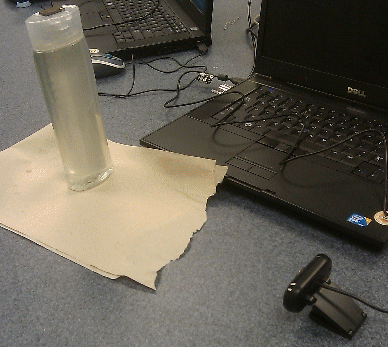
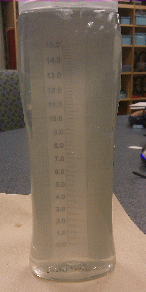
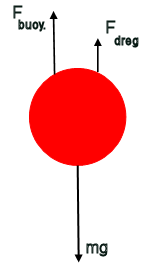
In this lab, you will explore fluid flow using a simulation. Then you will determine the viscosity of a brand of "Volumizing Shampoo" using Stokes' law. You will use a fluid column as a viscometer and measure the rate of descent of a steel sphere, as it falls under the influence of gravity through the fluid, after the sphere has reached terminal velocity.
Open a Microsoft Word document to keep a live journal of your experimental procedures and your results. Include all deliverables, (data, graphs, analysis, outcome). Write a 'mini-reflection' immediately after finishing each investigation, experiment or activity, while the logic is fresh in your mind.
The equation of continuity
Liquids are incompressible. Their density ρ = mass/volume is constant.
When a liquid flows through a pipe, conservation of mass leads to the
equation of continuity.
Consider the flow of a fluid through a pipe with varying cross sectional area A.
The volume V1 of liquid flowing into the pipe equals the volumeV2 flowing out of the pipe per unit time.
V1/Δt = V2/Δt, A1Δx1/Δt = A2Δx2/Δt, A1v1 = A2v2.
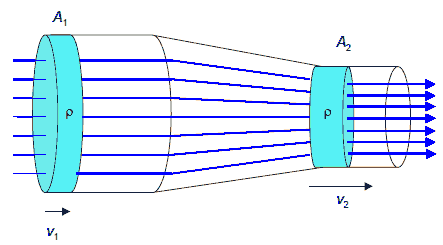
For the pipe we write the equation of continuity as A1v1 = A2v2, or Q = Av = constant. Q is called the volume flow rate.
Open the simulation
http://phet.colorado.edu/en/simulations/fluid-pressure-and-flow
to investigate the flow of a liquid in a pipe.
The interface
- Try all the different tabs at the top of the simulation.
- "Reset All" resets only the tab that you are presently using.
- You can use multiple tools to make measurements.
- Sensors are very sensitive, so you may expect some variations in the readings.
Flow tab
- The handles on the "Flow" tab let you change the shape/height of the water tube and end pipes.
- You can pause the simulation and then use increment time in discreet steps.
Water Tower tab
- Water is allowed to flow out of a hole at the bottom of a tall water tower.
Exploration 1:
Click the Flow tab.
Part (a)
- Reset all. Choose no friction. For the fluid density choose water.
Keep the flow rate at 5000 liter/s = 5 m3/s. - Case 1
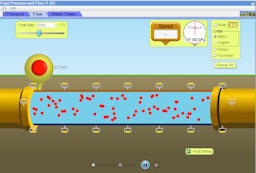
- Measure the diameter of the pipe and hose and the flow speed of the fluid.
- Measure the pressure at the bottom of the pipe.
- Record all values in table 1.
- Click the red button to get a representation of the profile of the
flow.
- Case 2
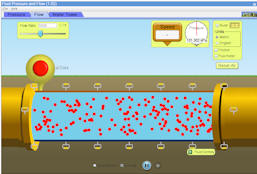
- Change the diameter of the pipe and hose by pulling all the lower handles down as far as possible.
- Measure the diameter of the pipe and hose and the flow speed of the fluid.
- Measure the pressure at the bottom of the pipe.
- Record all values in table 1.
- Click the red button to get a representation of the profile of the flow.
- Case 3
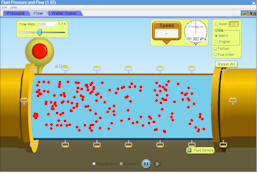
- Change the diameter of the pipe and hose again by pulling all the upper handles up as far as possible.
- Measure the diameter of the pipe and hose and the flow speed of the fluid.
- Measure the pressure at the bottom of the pipe.
- Record all values in table 1.
- Click the red button to get a representation of the profile of the flow.
- Case 4
- Keep the diameter of the pipe and hose the same as in case 3.
- Change the fluid density first to gasoline and then to honey.
- Measure the flow speed of the fluid.
- Measure the pressure at the bottom of the pipe.
- Record all values in table 1.
- Click the red button to get a representation of the profile of the flow.
Table 1
| density | pipe diameter (m) | flow speed (m/s) | pressure (kPa) | flow rate Q = vA m3/s) |
|
|---|---|---|---|---|---|
| case 1 | water | ||||
| case 2 | water | ||||
| case 3 | water | ||||
| case 4 | gasoline | ||||
| honey |
From your measurements, for all cases, calculate the volume flow rate in m3/s and record it in the table.
Part (b)
Reset all.
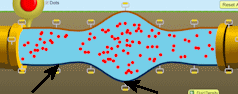
- Move the yellow handles in the middle of the pipe to their extreme up and down positions, while leaving everything else untouched.
- Measure the pressure as close to the middle of the pipe as possible at two different locations in the pipe near the handles pointed to by arrows in the figure above.
- At the same locations, measure the diameter of the pipe and the flow speed.
- Record your measurements in table 2 and calculate the volume flow rate for both locations.
Table 2
| density | pipe diameter (m) | flow speed (m/s) | pressure (kPa) | flow rate Q = vA (m3/s) |
|
|---|---|---|---|---|---|
| location 1 | water | ||||
| location 2 | water |
Part (c)
Now reset all. Turn on friction. Adjust the flow rate so that the speed as close to the wall of the straight pipe as you can measure is 0.6 m/s and find the speed in the middle of the pipe.
Exploration 1 Deliverables: (to be included in the your journal)
- Visuals: Table 1 and table 2
- Analysis:
- What information about the flow of a fluid in a pipe can you extract from
table 1?
Describe the the profile of the flow. Is it the same for all cases? - What information about the flow of a fluid in a pipe can you extract from table 2?
- For the viscous flow how does the speed of the liquid in the middle of the pipe compare to its speed close to the wall? Describe the the profile of the flow. Compare it to the profile without friction.
- What information about the flow of a fluid in a pipe can you extract from
table 1?
Exploration 2
Click the Water Tower tab.
Do some exploring! Fill the tank. Let the water partially drain out by opening the hole in the bottom of the tank. Match the leakage to keep water level in the tank constant. Raise and lower the tank. Measure the speed of the fluid just as its exits the tank and the horizontal distance the water travels until it hits the ground.
Exploration2 Deliverables: (to be included in the your journal)
- Analysis:
- Keeping everything else the same, does the flow speed of the water depend upon the
height of water level in the tank?
Justify your answer by giving the numbers for the flow speed for two different water levels. - Keeping everything else the same, does the speed of the flow of the water depend upon the
height of the tank?
Justify your answer by giving the numbers for the flow speed for two different tank heights. - Does the speed of the flow depend upon the fluid density?
Justify your answer by describing how you checked this?. - What happens to the stream of fluid after it leaves the tank?
- How far (horizontally) will a
stream of water travel if it exits the water tower at 14 m/s, 10 m above the
ground?
(Click "Match Release", open the hole in the bottom of the tank, and then click "Fill". Use the yellow handle to move the tank vertically.) - You are designing a temporary gravity-fed water system for a campsite. If the flow is too weak for a shower, should you buy a wider tank or put the current tank on a taller platform? Use the simulation to prove your choice.
- Keeping everything else the same, does the flow speed of the water depend upon the
height of water level in the tank?
Viscosity
Viscosity is a measure of a fluids resistance to relative motion within the fluid. Highly viscous fluids do not readily flow. The viscosity of a fluid usually varies with temperature. For a fluid flowing through a pipe in laminar flow, viscosity is one of the factors determining the volume flow rate.
Poiseuille's law: Q = π∆Pr4/(8ηL)
Volume flow rate = π*(pressure difference)*(pipe radius)4/[8*(pipe length)*viscosity)
Exercise
Blood is a viscous fluid circulating through the human body. The circulatory system is a closed-loop system with two pumps. One-way valves keep the flow unidirectional. A sketch is shown below. The unit of pressure in the sketch is mm Hg. (1 atm = 760 mm Hg)
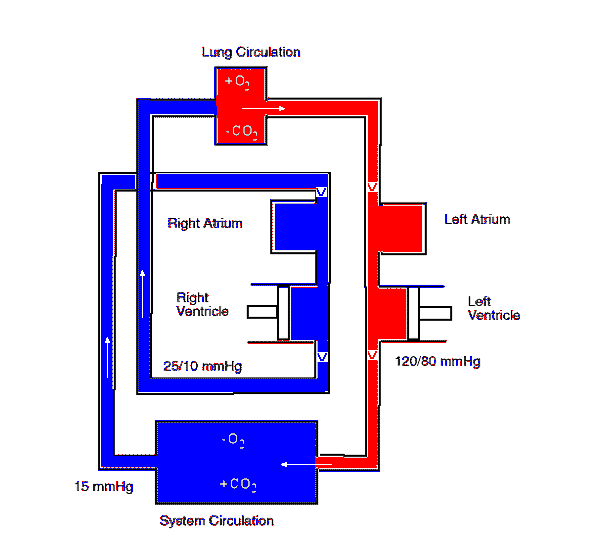
During heavy exercise, the blood's volume flow rate is 5-10 times higher than when the body is at rest. Discuss different possible ways that a body can accomplish this?
- Is increasing blood pressure 5 - 10 times higher a viable option? What percentage increase in blood pressure is reasonable? Explain!
- Is decreasing the length of your blood vessels a viable option? Explain!
- The arterioles (small arteries) are surrounded by circular muscles.
In order to increase the blood flow rate by a factor of 5, what percentage increase in the radius of a blood vessel is needed? (This is called vasodilatation.) - Arteries in the human body can be constricted when plaque builds up on the inside walls. How does this affect the blood flow rate through this artery? Is it possible for the body to keep the flow rate constant? Explain!